
You bought the car. Now you need to charge it at home, and a quick search throws up a dozen brands, a wall of specs, and a price range wide enough to drive through. Most of it is noise. Once you know what actually matters, the decision gets simple.
Here is how we think about it, after years of installing EV chargers in real homes.
First, know what a home charger actually does
Almost every EV sold in Australia comes with a basic portable charger that plugs into a normal power point. It works, but it is slow, and it ties up a socket for most of the day. A proper wall-mounted charger is faster, safer, and built to live outside on your wall for the next decade. That is what we are talking about here.
The good news: nearly every smart charger on the market will charge your car perfectly well. The differences are in the details, and those details are what decide whether you are happy with it in three years.
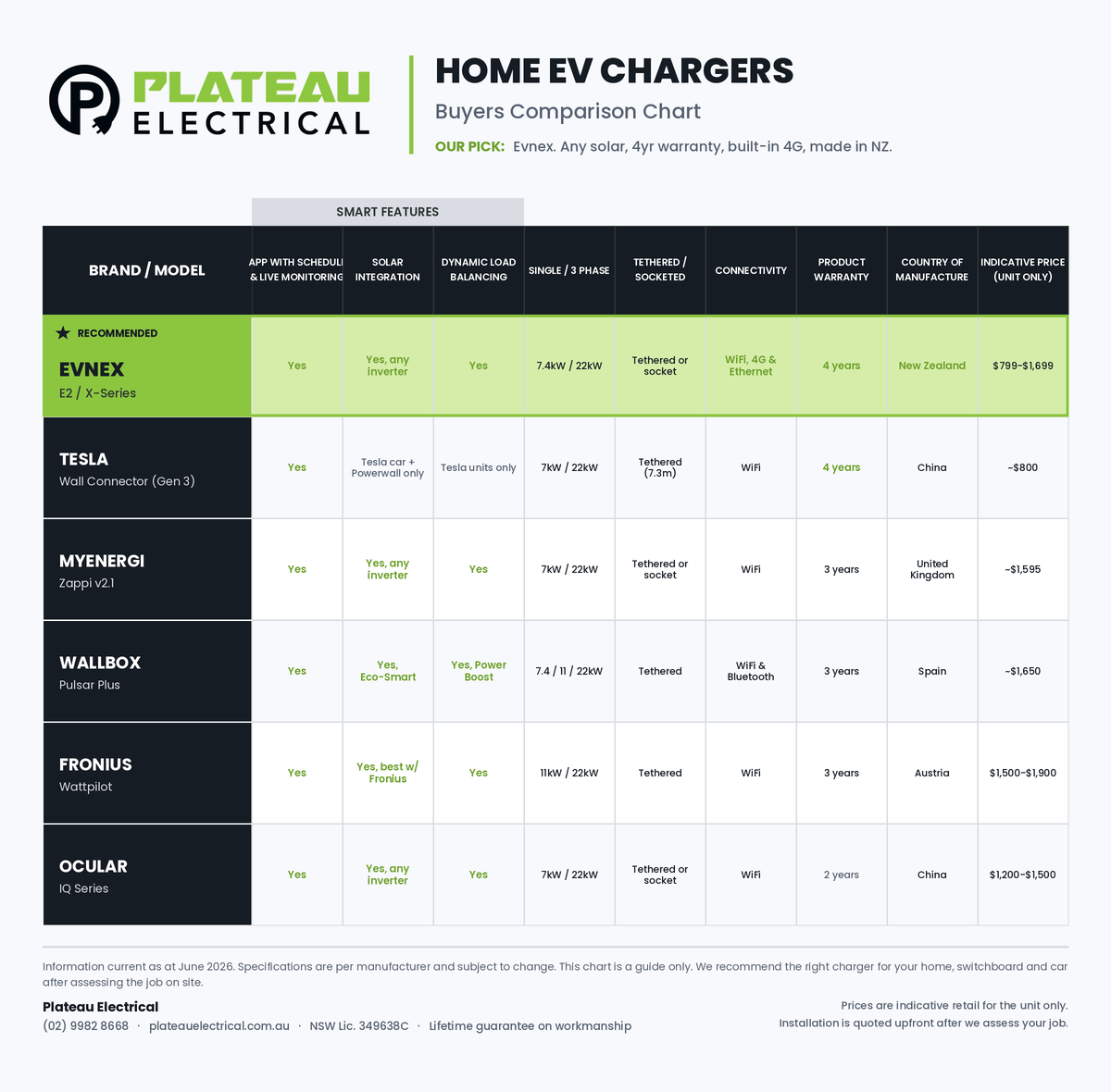
Charging speed: single phase or three phase
This is the first fork in the road, and it is decided by your house, not the charger.
Most homes have single-phase power, which tops out around 7kW. That adds roughly 40km of range per hour, so a typical overnight charge easily covers daily driving. If your home has three-phase power, you can run a charger up to 22kW and add range far faster.
Here is the honest part: for the vast majority of households, 7kW single phase is plenty. You sleep, the car charges, you wake up full. Paying for 22kW only makes sense if you genuinely drive big distances daily or you already have three-phase power sitting there. Before you spend money chasing speed, it is worth having your switchboard and supply looked at, because that is what sets your real ceiling. An electrical safety inspection tells you exactly what your home can handle.
Solar integration: the feature that pays you back
If you have solar panels, this is the feature worth caring about most.
A charger with solar integration watches what your panels are exporting and tops up the car with that free energy instead of sending it back to the grid for a few cents. Set it to "solar only" or "solar boost" and your car effectively charges on sunshine. Over a year, that adds up to real money.
Not all chargers do this equally well. Some need extra hardware or a matching brand of inverter to unlock it. Others read your whole-home energy at the switchboard and work with any solar system you already own. If you have panels, ask the question early and do not assume it is built in.
Dynamic load balancing: protecting your switchboard
This one sounds technical but the idea is simple. Dynamic load balancing lets the charger sense how much power the rest of your house is using and dial itself back so it never overloads your supply. Oven, kettle, air con and car all running at once? The charger quietly steps down instead of tripping the main switch.
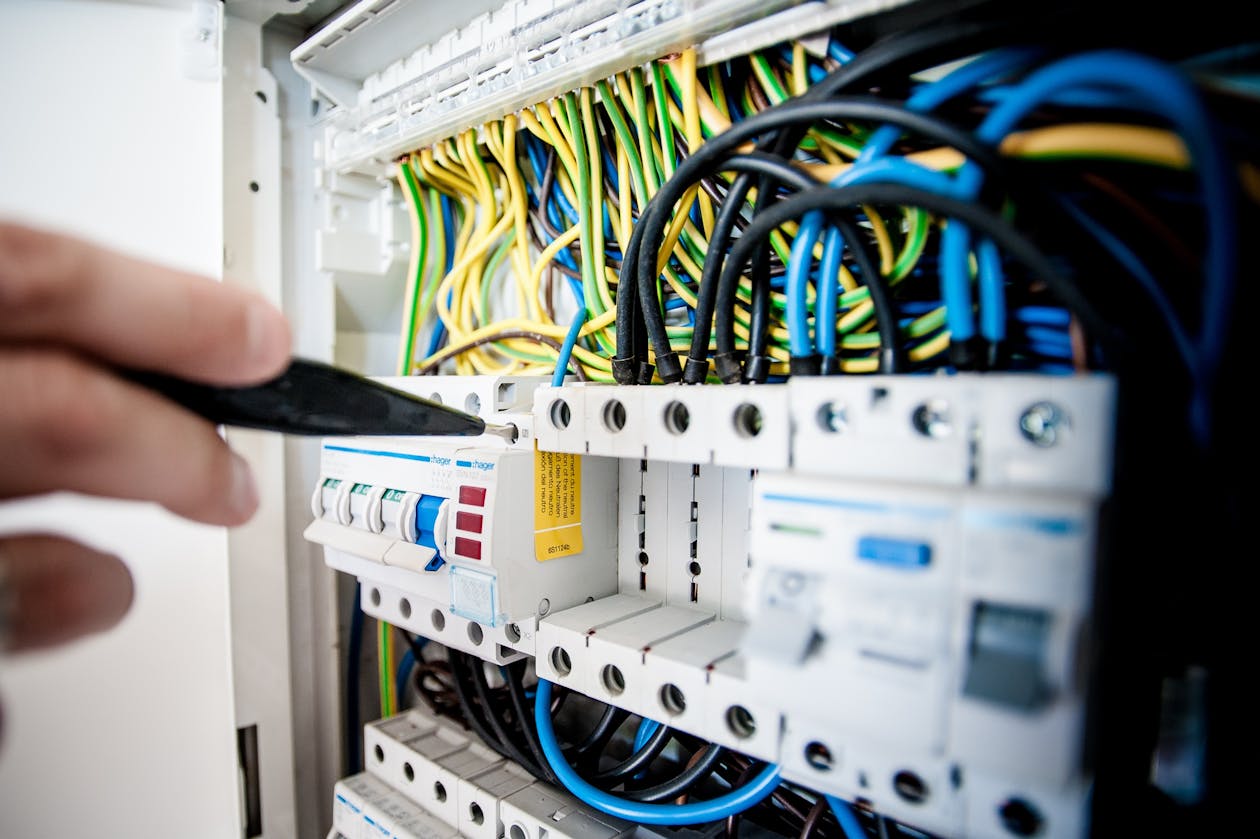
On older homes, or any home where the switchboard is already working hard, this is the difference between a charger that just works and one that becomes a nuisance. It is also why the box you buy matters less than the install around it. A great charger wired into a tired switchboard is still a problem waiting to happen.
Tethered or socketed
A tethered charger has the cable permanently attached. You pull up, plug in, done. A socketed unit has a bare socket and you use your own cable, which keeps the wall tidier and lets you swap cables if standards change.
For most homeowners, tethered is the more convenient choice day to day. There is no wrong answer here, it is personal preference, and plenty of brands offer both.
The smaller things that still matter
A few details separate a charger you tolerate from one you forget about because it just works:
- App and scheduling. A good app lets you set charging windows for off-peak rates and see live status. Nearly all smart chargers have this now.
- Connectivity. Most chargers connect over WiFi. If your meter box is far from the router, look for one that also offers 4G or Ethernet, or you will be fighting a weak signal forever.
- Warranty. Warranties range from two to four years. A longer warranty is a fair signal of how much the maker trusts their own hardware.
- Weather rating. Anything mounted outside should be properly weatherproofed for Australian conditions.
The brands worth knowing
Plenty of solid chargers are sold here. A few you will come across again and again:
- Tesla Wall Connector. Clean, reliable, and a sharp price, but its smart features lean toward Tesla's own ecosystem and it is light on open solar control. We install plenty of them and are a fully accredited Tesla charger installer.
- myenergi Zappi. A favourite among solar households thanks to genuinely good solar diversion.
- Wallbox Pulsar Plus. Compact and well-featured, with solar and load balancing built in.
- Fronius Wattpilot. A natural fit if you already run a Fronius solar inverter.
- Ocular IQ. A capable all-rounder that covers the basics well.
Whatever badge is on your car, the charger does not have to match it. We are accredited installers across Tesla, BMW, Kia, Polestar and Mazda, and we will match the charger to your home and your driving, not to a logo.
Our pick: Evnex
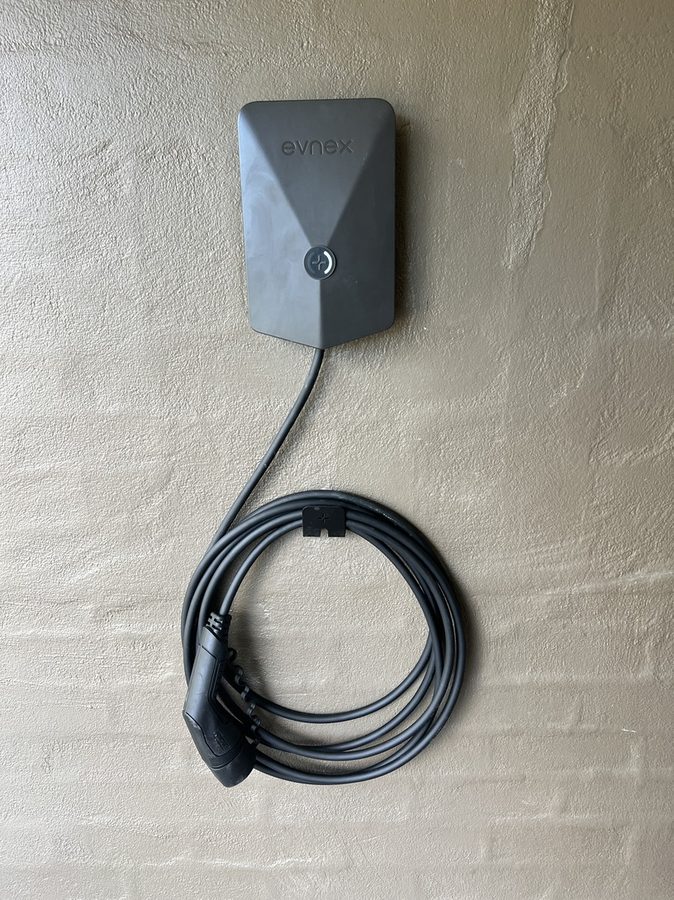
If you asked us to put one charger on the wall and walk away knowing you would be happy, it would be an Evnex.
The reasons are practical. Its solar integration works with any inverter brand, so you are not locked in. It carries a four-year warranty, which is at the top of the field. It is the one charger here with built-in 4G and Ethernet as well as WiFi, which quietly solves the most common real-world headache: a meter box too far from the router. And it is designed and built in New Zealand, which shows in the quality.
It is not the cheapest box on the wall, and that is the point. It is the one we would put in our own home and at our grandma's house, which is the only test that has ever mattered to us.
The part most guides skip: the install matters more than the box
Here is the thing nobody selling you a charger will tell you. The unit on the wall is maybe half the decision. The other half is the install: the condition of your switchboard, the cable run, the load on your supply, and whether the person doing the work knows how to set the charger up properly so it actually behaves.
That is where a good charger goes wrong in the wrong hands, and where an average charger can run faultlessly for years in the right ones. It is also why we quote every job upfront after seeing it, so the price you are told is the price you pay, with no surprises at the end. Every install is backed by our lifetime guarantee on workmanship.
If you are weighing up a charger, the most useful next step is not more spec sheets. It is having someone look at your home and tell you straight what fits. That is what we do. You can book a visit through our contact page, and if you want to know who you are dealing with first, here is a bit more about us.
Get the charger right once, properly, and you will not think about it again. That is the whole goal.
.jpg)
